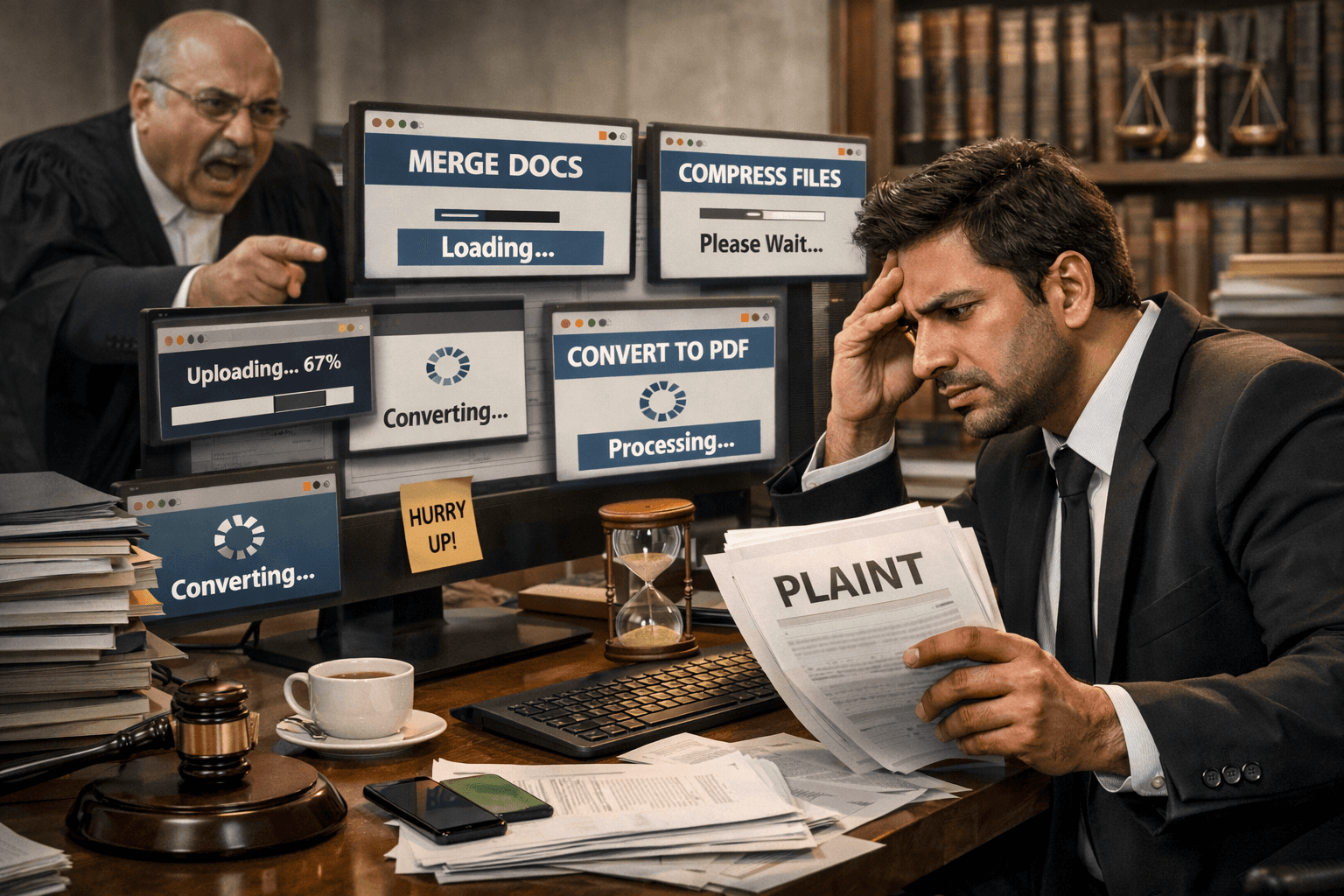
The ₹27-Crore AI Gamble - Why Courts Are Rejecting Generic Legal AI
When legal research becomes guesswork, the fallout is brutal; because courts don’t tolerate fiction where facts, citations, and credibility matter most.
Authored by

Shivangi A.
Lead Legal Researcher

A single hallucinated citation can turn a courtroom argument into a career-defining mistake.
In October 2025, the Bombay High Court confronted a tax officer who used a generative AI chatbot to invent three fake precedents, resulting in an unlawful ₹ 27.91 crore tax demand against a private company.
The legal profession is currently navigating the most aggressive technological transition in its history. Litigators are being heavily pressured by clients, managing partners, and general counsel to operate faster and leaner. Artificial intelligence is positioned as the definitive answer to volume constraints. But the execution of this transition is failing in a highly visible, highly damaging manner.
Lawyers are applying general-purpose chatbots to highly specific, zero-tolerance litigation workflows. The consequence is a global outbreak of professional embarrassment, financial sanctions, and judicial reprimands.
When an advocate treats a predictive text generator like a legal research database, they are gambling their Bar license on the mathematical probability of a sentence fragment.
Courts in India and abroad are losing patience. They have drawn a hard line regarding attorney responsibility in the age of generative models. You cannot outsource your verification duty to an algorithm.
If your name is on the vakalatnama, you own the hallucination and you take liability of the outcome.
If you are a litigator currently deploying open-domain chatbots for matter management, citation tracking, or drafting, you are exposed to a severe malpractice risk. The era of blind AI trial runs is over.
What "AI for Lawyers in India" Actually Means Right Now
To understand why courts are aggressively sanctioning legal practitioners, you must understand the mechanical failure points of consumer artificial intelligence.
Lawyers are fundamentally professionals of text. When you encounter software that outputs perfect, grammatically flawless legal English, the human brain instinctively attributes comprehension to the machine. You assume that because it writes exactly like a senior advocate, it thinks like one. This singular cognitive error is the root cause of every AI malpractice claim currently hitting the dockets.
Consumer-grade AI models do not read the law. They do not maintain a rigidly updated database of Supreme Court judgments, High Court dissents, or statutory amendments. They are probabilistic text engines. Their sole operational function is to predict the next mathematically probable word in a sequence based on vast, unfiltered internet datasets.
When you ask a general chatbot for a case on Section 63 of the Bharatiya Sakshya Adhiniyam, it does not retrieve a document. It generates text that syntactically resembles a citation. It invents a convincing "vs.", attaches an authentic-sounding year and volume number from a random reporter, and serves it back to you with absolute fabricated confidence.
The software categorises this as a perfect success because it successfully mirrored the pattern of a legal citation. The advocate who physically files that generated text in an Indian courtroom commits professional misconduct.
How Generic Litigation AI Becomes a Liability
We do not have to guess what happens when these mechanical failures enter a real courtroom. The consequences are already part of the permanent judicial record. Administrative bodies, tribunals, and High Courts are actively prosecuting AI negligence.
The Bombay High Court's recent intervention in KMG Wires exposes how deeply this issue permeates the system. The National Faceless Assessment Centre (NFAC) escalated an assessment using an artificial intelligence tool. The system hallucinated three entirely fabricated judicial decisions. Operating on this spectral jurisprudence, the assessing officer imposed a catastrophic ₹27.91-crore tax demand on the company.
The mechanism was broken, and the High Court had to visibly rebuke the authority. The bench declared unequivocally that quasi-judicial officers cannot blindly depend on automated, unchecked search outputs when adjudicating vital rights.
Mere weeks earlier, the Delhi High Court dealt with the exact same phenomenon originating from the private bar. The Greenopolis Welfare Association filed a petition aggressively relying on extracts of Supreme Court judgments. When senior counsel for the respondents scrutinized the documentation, the truth abruptly surfaced: the textual evidence was completely non-existent. The excerpts were AI-generated hallucinations. The petitioner was forced into a humiliating withdrawal before the bench.
The highest levels of the Indian judiciary are acutely aware of the systemic threat. Speaking directly to the phenomenon in Nairobi in March 2025, Supreme Court Justice B.R. Gavai formally flagged the crisis of AI-induced legal fiction. He explicitly named consumer platforms like ChatGPT and Gemini, warning that their documented tendency to fabricate legal facts and citations poses a direct, existential risk to the basic integrity of judicial proceedings.
Judicial patience outside of India expired over a year ago. American dockets demonstrate the financial trajectory of AI negligence. During the appellate proceedings for Kruse v. Karlen, a pro se litigant submitted a brief heavily reliant on an AI "consultant." Of the 24 case citations provided to the bench, 22 were complete AI fabrications. The Missouri Court of Appeals did not simply mandate a withdrawal; they dismissed the appeal entirely and sanctioned the party $10,000 for filing frivolous and deceptive material, noting that opposing counsel was forced to expend extensive resources chasing nonexistent law.
Industry debate regarding the Kruse litigation also frequently references a heavily circulated, purportedly associated California Court of Appeals ruling dated July 2025. This brief alleges the imposition of concurrent $10,000 sanctions and documents a sharp, definitive rebuke from Justice Bybee: "Technology is no excuse for eschewing legal research." Regardless of the jurisdictional nuances, the global standard from the bench remains aggressively unified: you own your output. The algorithm does not.
The Statistical Cost of Negligence
The legal profession finds itself trapped between commercial efficiency mandates and strict judicial liability. Broad internal industry research suggests a volatile paradox: 79% of legal professionals adopted artificial intelligence into their workflows in 2024, yet 62% remain deeply alarmed by accuracy flaws, data privacy, and the specific threat of hallucinations.
What is empirically verified by institutional research validates this momentum. A staggering 77% of professionals broadly expect AI to exert a high or transformational impact on their daily outputs and core responsibilities.
This data paints a terrifying picture of the modern Indian litigation landscape. We have mass adoption of a technology completely mismatched to the precision requirements of its users. Current baseline accuracy mapping exposes the core of the problem. Broad industry data puts generic AI accuracy at approximately 85% for complex legal evaluation tasks, whereas specialized legal algorithms cross the 98.5% reliability threshold.
An 85% success rate is perfectly acceptable if you are drafting an internal email, summarizing a generic marketing brief, or brainstorming operational ideas. But if you are drafting a Special Leave Petition or compiling a list of binding precedents for an active trial, a 15% failure rate is terminal. Every single citation must be flawless.
You cannot approach a High Court judge with an apology about software glitches. The duty of candour to the tribunal is absolute. The Bar Council demands that an advocate exercises independent professional judgment and verifies every assertion presented as legal fact. If you fail to verify a machine-generated assertion, you have committed malpractice.
What This Means for Your Practice
The reality of litigation AI in India today is binary. You can choose to expose your practice to the catastrophic liability of consumer chatbots, hoping you catch their hallucinations before the judge does. Or you can deploy software that refuses to guess, operating exclusively within the four corners of your verified documents. The courts have already signaled how they will treat those who guess incorrectly.
If you manage active litigation and want case intelligence that stays ruthlessly faithful to your documents not internet-trained guesswork that risks your reputation that is exactly what Superlaw does. Stop gambling your practice on generic chatbots. Experience secure, bounded, verifiable litigation AI at superlaw.co.